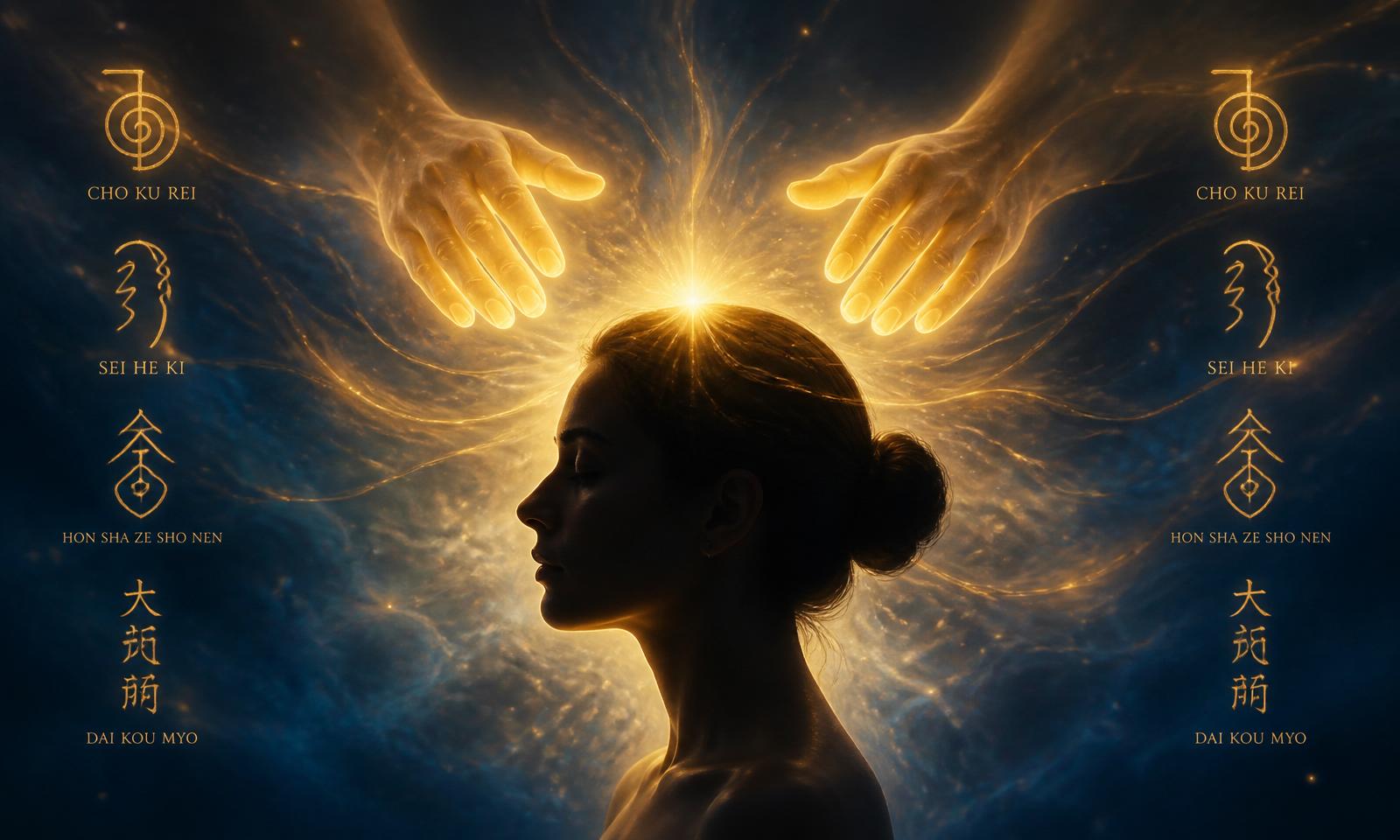
In a world moving at impossible speed, an ancient Japanese healing art has quietly returned to answer the one question modern medicine cannot: how do we restore the energy that makes us feel truly alive? Reiki is that answer — a gentle, universal life-force healing that dissolves stress, unblocks the body's subtle rivers and restores the sacred balance between mind, body and soul.
What is Reiki?
The word Reiki (霊気) comes from two Japanese kanji: Rei, meaning universal or higher intelligence, and Ki, meaning life-force energy — the same vital force known as Prana in India and Chi in China. Together, Reiki translates to "spiritually guided universal life energy."
Reiki is a non-invasive, hands-on (or hands-above) healing modality in which a trained practitioner channels this universal energy through their palms into the recipient's energy body. It is not massage. It is not hypnosis. It is not religious. It is a pure transfer of coherent, high-frequency energy that supports the body's innate ability to heal itself.
When Ki flows freely, we are healthy, calm, creative and abundant. When Ki is blocked — by stress, trauma, negative thoughts, environmental toxins or unresolved emotion — we experience disease, fatigue, anxiety or stagnation in our lives. Reiki restores that flow.
History of Reiki
The modern Reiki system was founded in Japan in 1922 by Mikao Usui, a Japanese Buddhist and spiritual seeker. After a 21-day meditation and fast on the sacred Mount Kurama, Usui experienced a profound spiritual awakening in which the symbols and attunements of what would become the Usui System of Natural Healing (Usui Shiki Ryoho) were revealed to him.
Usui spent the rest of his life teaching Reiki and healing thousands in Japan. Before his passing in 1926, he initiated Chujiro Hayashi, a former naval officer, who systematized Reiki into clinical hand positions and levels. Hayashi in turn trained Hawayo Takata, a Japanese-American woman who brought Reiki to Hawaii in 1937 — and from there to the entire Western world.
Today, Reiki is practiced in over 80 countries, taught in more than 800 hospitals worldwide (including major institutions like the Cleveland Clinic and Memorial Sloan Kettering) and is recognized by the NIH as a form of complementary energy medicine.
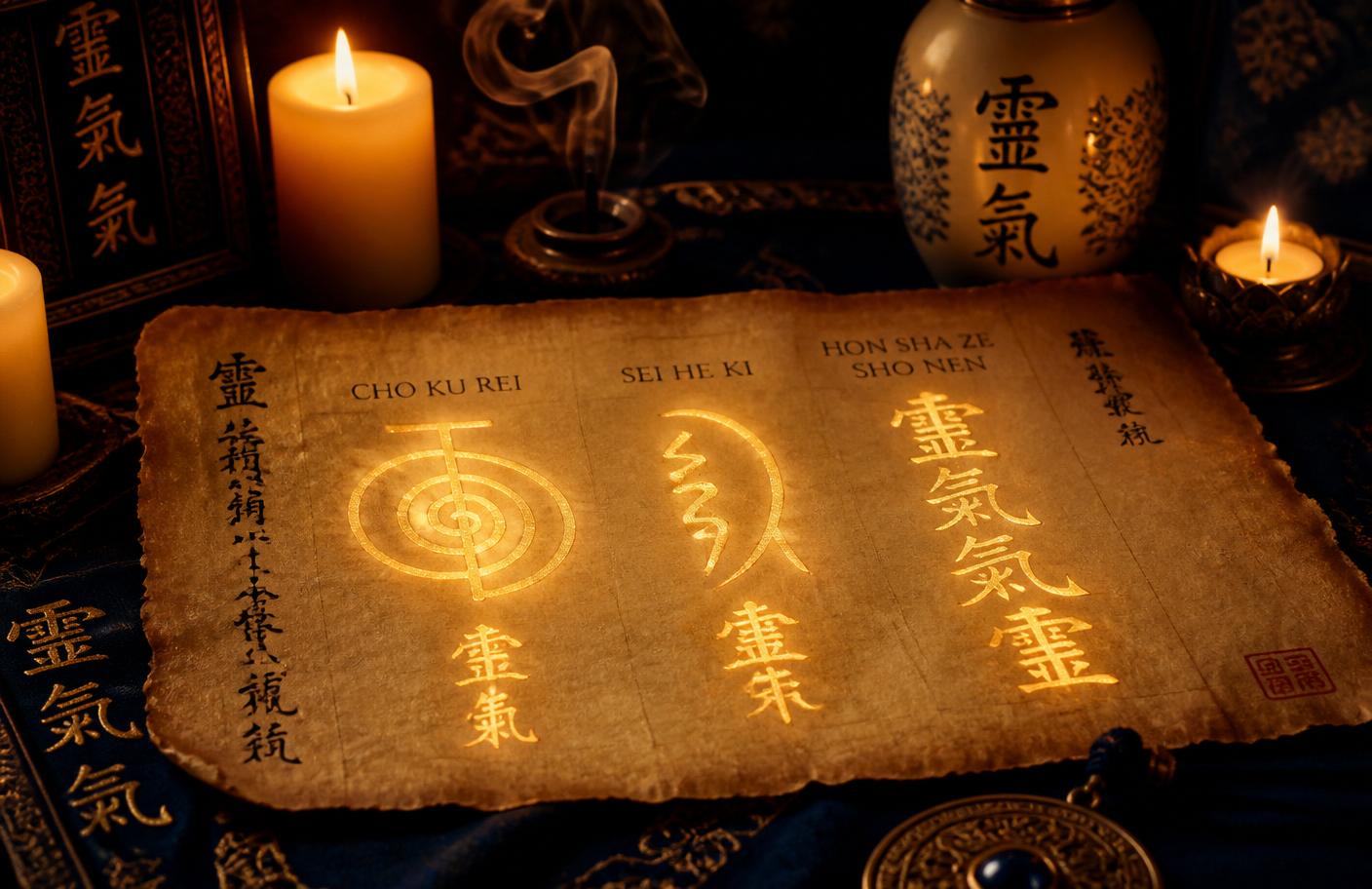
The Sacred Reiki Symbols — Cho Ku Rei · Sei He Ki · Hon Sha Ze Sho Nen
How Reiki Works
Every living being is surrounded by a subtle electromagnetic field — the aura — and animated by an internal network of energy centres (chakras) and channels (nadis / meridians). Reiki works on this biofield, not on the physical body directly.
During a session, the practitioner acts as a hollow reed — a conduit through which universal life force flows. The energy enters through the practitioner's crown chakra, moves through the heart and exits through the palms into the client's energy field. The client's own higher intelligence then directs the energy to wherever imbalance exists — a shoulder holding tension, a heart holding grief, a nervous system stuck in fight-or-flight.
The Reiki Session — What to Expect
- You lie fully clothed on a massage table or recline in a chair.
- The practitioner places hands lightly on or slightly above 12–15 standard positions covering the major chakras.
- You may feel warmth, tingling, gentle pulsing, deep relaxation, waves of emotion, or fall into a meditative sleep.
- Sessions last 45–75 minutes. The healing continues for 24–72 hours afterwards.
Scientific Perspective
Reiki is ancient, but its effects are increasingly measurable. Published studies in journals like the Journal of Alternative and Complementary Medicine and the Journal of the American Board of Family Medicine have documented Reiki's effects on:
- Heart rate variability — a key marker of nervous system balance.
- Cortisol reduction — measurable drops in the stress hormone after a single session.
- Post-surgical recovery — reduced pain, anxiety and hospital stay length.
- Cancer care — improved quality of life, less nausea and fatigue during chemotherapy.
- Anxiety and depression — clinically significant reductions in double-blinded trials.
Emerging research in biofield science — pioneered at institutions like HeartMath and NIH's National Center for Complementary and Integrative Health — is beginning to map the coherent electromagnetic fields that healers generate through their hands, offering a scientific vocabulary for what mystics have known for millennia.
Benefits of Reiki Healing
Reiki is a whole-being healing. It doesn't target a symptom — it restores the coherence of the entire energetic system. Its benefits cascade across four dimensions of your being:
Physical Benefits
- Deep relief from chronic pain, migraines & tension
- Faster recovery from illness, surgery & injury
- Improved sleep quality and immune function
- Balanced blood pressure and hormonal system
- Reduced inflammation and detoxification support
Mental Benefits
- Sharper focus, clarity and decision-making
- Release of mental loops, overthinking and worry
- Improved memory and creative problem-solving
- Freedom from destructive thought patterns
- Deep, meditative stillness of mind
Emotional Benefits
- Gentle release of grief, anger, fear & trauma
- Emotional resilience and equanimity
- Healing of relationship wounds and heartbreak
- Higher self-worth and self-love
- Ability to feel joy, gratitude and peace again
Spiritual Benefits
- Reconnection with your higher self and purpose
- Awakening of intuition and inner guidance
- Alignment with abundance and divine timing
- Deeper meditation and expanded awareness
- A living, felt sense of oneness with the universe
Reiki & The Seven Chakras
Reiki flows through and harmonizes the seven main chakras — the spinning wheels of light along the spine that govern every aspect of your physical, emotional and spiritual life. When one chakra is closed or overactive, the entire system falls out of tune. Reiki gently retunes each one, like a master musician re-stringing a sacred instrument.
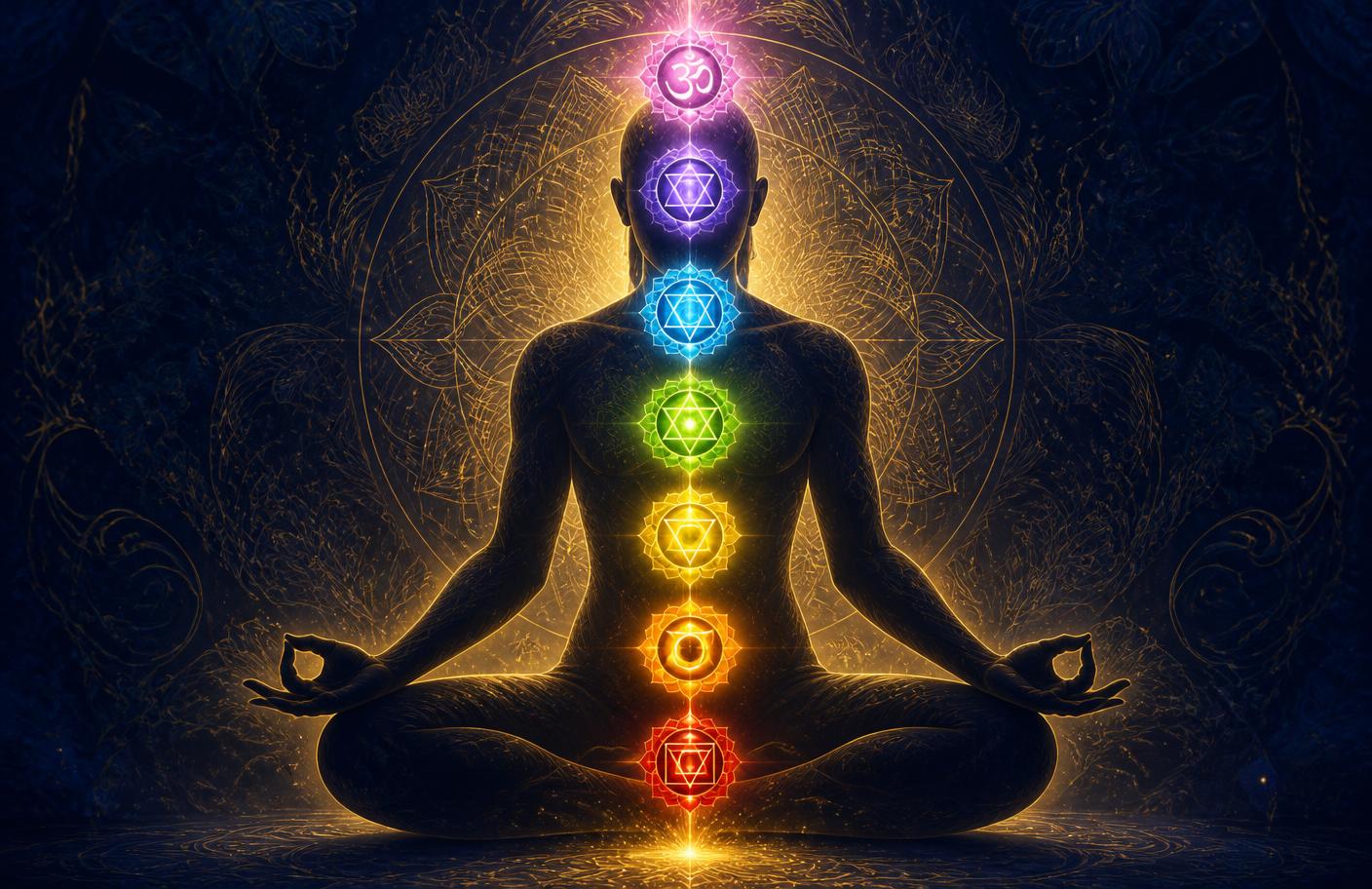
Root — Muladhara
Safety, grounding, survival, stability.
Sacral — Svadhisthana
Creativity, sensuality, emotional flow.
Solar Plexus — Manipura
Confidence, willpower, personal power.
Heart — Anahata
Love, compassion, forgiveness, connection.
Throat — Vishuddha
Truth, expression, authentic communication.
Third Eye — Ajna
Intuition, insight, inner vision.
Crown — Sahasrara
Higher consciousness, divine connection.
Common Myths About Reiki
Myth
Reiki is a religion.
Truth
Reiki has no dogma, no deity and no belief system. It is a universal energy practice that complements every faith — and no faith at all.
Myth
Only 'gifted' people can do Reiki.
Truth
Reiki is not a talent — it is a channel that opens through attunement. Anyone who receives an attunement from a qualified Reiki Master becomes a channel for life.
Myth
Reiki takes years to learn.
Truth
The foundational level (Reiki 1) can be learned in a single weekend and allows you to heal yourself and others immediately.
Myth
Reiki replaces medical treatment.
Truth
Reiki is complementary — never a replacement. It works beautifully alongside doctors, therapy, medication and surgery, often accelerating recovery.
Myth
You can 'absorb' someone's negative energy.
Truth
Because Reiki flows through you and not from you, the practitioner is never depleted. In fact, the healer receives healing every time they give it.
Who Can Learn Reiki?
The short and beautiful answer: anyone. Reiki does not discriminate by age, gender, culture, background or belief. However, Reiki most powerfully calls those who are:
- Feeling stuck, exhausted or spiritually thirsty in modern life.
- Drawn to healing themselves and their families.
- Therapists, doctors, nurses, yoga teachers and coaches seeking a deeper healing dimension.
- Empaths and sensitive souls who need energetic protection and tools.
- Seekers on a spiritual path who want a daily practice that actually works.
- Parents wanting to raise energetically balanced children.
Is Reiki Safe?
Reiki is one of the safest healing modalities in existence. It cannot be overdosed. It cannot harm. It works only for the highest good of the receiver — even a child, an animal or an unconscious patient can safely receive Reiki.
It is safe during pregnancy, during illness, alongside medication and after surgery. The only "side effects" are gentle detox reactions — mild fatigue, vivid dreams, or emotional release — as the body integrates the healing.
Frequently Asked Questions
Can Reiki be learned by anyone?+
Yes. Reiki is universal life force energy — it is available to anyone regardless of age, background, religion or prior spiritual experience. It is passed on through an attunement by a qualified Reiki Master and, once received, stays with you for life.
Do I need to believe in Reiki for it to work?+
No. Reiki works on the energetic level whether or not the receiver believes in it. Openness enhances the experience, but even skeptics regularly report deep calm, warmth and relief during a session.
Is Reiki a religion?+
Reiki is a spiritual practice, not a religion. It has no dogma, no worship and no conflict with any faith. Christians, Hindus, Muslims, Buddhists and atheists all practice Reiki.
How many sessions do I need?+
Most people feel a noticeable shift after a single session. For deeper physical, emotional or karmic issues, 3–7 weekly sessions are typically recommended to allow the energy to work through multiple layers.
Can Reiki be done remotely?+
Yes. Distance Reiki using the Hon Sha Ze Sho Nen symbol is as effective as in-person healing. Energy is not bound by time or space.
Are there side effects?+
Reiki is completely safe. Some people experience gentle detox symptoms — vivid dreams, mild fatigue or emotional release — for 24 to 72 hours as the body integrates the healing.
Final Conclusion
Reiki is not a trend. It is not a technique you learn and forget. It is a remembering — a re-connection to the intelligent, loving, infinite energy that has always been flowing through you, waiting for you to notice.
In a lifetime measured by deadlines and dopamine, Reiki offers a different measure entirely: the depth of your breath, the softness of your heart, the clarity of your intuition and the quiet coherence of a life lived in tune with the sacred current beneath everything.
If any part of you leaned in while reading this — that was not coincidence. That was your own energy body whispering: begin.
Written by
Samita Modern Monk
Reiki Grandmaster, Vedic energy mentor and founder of the Modern Monk movement — guiding thousands of souls into a life of coherence, abundance and sacred power through ancient wisdom made modern.